
Let's Bring Back the Duel
Thirsty for Thersites//Class Morality

The other night, I was reading Moses Finely and Thorstein Veblen. The next morning, I was watching highlights from the 2000 NBA Finals between the Los Angeles Lakers and the Indiana Pacers. The two are related, and not just in that I engaged with both instead of finishing a paper for a class. Today, I’d like to talk about heroic morality and the leisure class. Apropos, given that our main summer blockbuster today is a re-telling of The Odyssey, and that some commentary is focused on whether or not a modern re-telling of the story of the return from Troy ought to be imbued with modern values, or whether it can help it.
According to Veblen’s theory, a leisure class develops, historically, out of a primordial barbarian warrior class. As the society they’ve conquered develops and incorporates them, the main way that they differentiate themselves from those over whom they rule is by an aversion to manual, menial labor. As such, these men need occupations, and, as Veblen says, “these occupations are government, war, sports, and devout observances”
In Anna Karenina, the country landowner Levin reflects on his position vis a vis the peasants who work his estate. He harangues the peasants to perform just such labor in just such a way; their interests lie in placating him “because all they wanted was to work merrily and carelessly, and his interest were not only remote and incomprehensible to them, but fatally opposed to their most just claims.”
A core idea here is that there are different perspectives, arising out of different social positions, from which there are differing standards of right and wrong. There are social roles, some permanent, some temporary and contingent dynamics, the morality of which will differ from the that of the preponderant class. For example, the helots of Sparta, and the slaves who did all the work in other Greek city-states, did not necessarily share the hero’s glory-seeking values in the time of Paris and Helen.
There’s actually an illustration of this in the Odyssey. “Only Thersites the loose-tongued kept on scolding, he whose heart was full of words, many and disorderly, quarreling with the kings vainly and not in good order.” “The substance of Thersites’ complaint”, says Finley, “was this: The devil with fighting to amass booty for Agamemnon; let us go home.” Whereupon Odysseus, bristling at this affront to the “foundations on which the world of Odysseus was erected”, smashed Thersites on the back and shoulders with a scepter, raising a bloody welt. Thersites was two steps from advocating the doctrine of revolutionary defeatism, and got the usual reward.
The point is that the values of the Odyssey, and the Iliad, did not necessarily reflect the prevailing values of the day; they represent the heroic values of the essentially amoral ruling class. However, for hundreds of years, the epic oral poems were recited as entertainment and education, socializing listeners in the morality of another class, not unlike ourselves today watching millionaires’ petty personal beefs, selfish pursuits of personal achievement, and vainglorious self-obsession, all of which would be rightly considered psychotic if these were characteristics of a friend of yours. When Michael Jordan or Odysseus embody them, however, they are seen as something admirable, something to mimic.
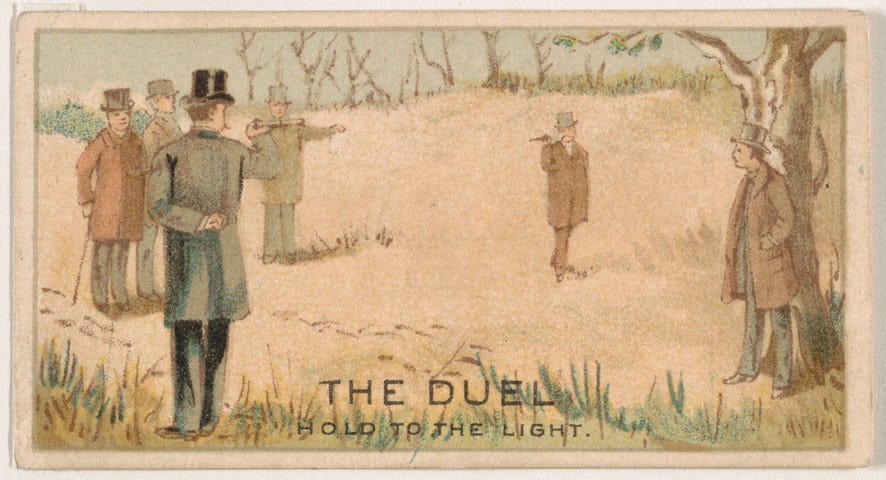
Honor, the anthropologist David Graeber said, is surplus dignity. How does one acquire this surplus? By taking dignity from others. It is “honorable”, for instance, to fight a duel when you are humiliated. By threatening, and potentially, taking a man’s life, or at least putting him in a position in which if he refuses the challenge, he himself is humiliated, you can win back your dignity. It is “honorable”, in this same sense, to humiliate a man in a basketball game, to dunk in his face, to break his ankles.
I think we may have found the solution in our little exploration here, the solution to the problem of having a leisure class with a different morality grafted onto our society: let’s bring back dueling. In the blood-spattered past, we were sometimes spared decades of strife by the wounded honor of some ruling class asshole. 1804, for example, that blessed year, served human freedom in that Toussaint Louverture’s revolution then liberated Haiti from the French, but also in that Aaron Burr saved the United States from years more of Alexander Hamilton.